

.png)
The People's Depot (TPD) is our beverage container redemption center currently operating under the Morrison Bridge. It is operated by canners, for canners—people who collect cans and bottles for income.
Ground Score is excited to announce that a prospective brick-and-mortar location has been identified for our depot at 1109 SE Brooklyn St. in Portland. This move will allow us to support our workers and customers better in a safe, indoor environment.
TPD, which is already a world-renowned model of inclusive recycling by creating formal jobs for informal recyclers, is happy to continue our partnership with the Oregon Beverage Recycling Cooperative (OBRC) to maintain an inclusive space for everyone to redeem their bottles and cans.
The People's Depot location and hours:
-
Current location: 800 SE MLK Jr. Blvd., Portland, OR 97214 (under the Morrison Bridge)
-
Hours: Mon-Fri from 9:30 am to 12 pm
-
Redemption limit: Up to 400 containers per person per day
-
Accepts: Aluminum cans and plastic and glass beverage containers that are redeemable for Oregon's 10-cent deposit*
-
Holidays: TPD is closed on New Year’s Day, Dr. Martin Luther King Jr. Day, Presidents’ Day, Memorial Day, Juneteenth, Independence Day, Labor Day, Indigenous Peoples Day, Veteran’s Day, Thanksgiving Day and the following day, Christmas Eve, and Christmas Day.
*Unfortunately, TPD cannot pay you for smashed containers or containers that have been run through a reverse vending machine. Any misshapen containers must have volume to them.
In March 2025, we surveyed 152 canners who visited The People’s Depot in partnership with the OBRC, DHM Research, Nick Hara, and volunteers from the City of Portland. Questions were asked verbally. You can find more info below and in the report link. Some notable findings included that:
-
TPD canners reported earning about $7.68/hour on average, which is less than half of the Portland metro area’s minimum wage of $16.30/hour.
-
Respondents reported collecting/redeeming containers 5 days/week on average for 6 hours/day, equivalent to a 30-hour work week.
-
On average, those surveyed had been canning for 10 years. This contradicts the stereotype that canning and Oregon’s Bottle Bill fuel the fentanyl crisis, which did not start in Oregon until 2020.
-
Canners were most likely to spend the money they earned on basic essentials (63%),
-
including food and non-alcoholic drinks (40%), bills (6%), transportation (5%), shelter (3%), medication and toiletries (3%), clothes/laundry (2%), family needs (3%), and savings (1%).
-
Black/African American canners reported making less on average than those of all other races/ethnicities ($21-$54 per transaction vs. $44-$96 per transaction for all respondents), despite the former working slightly longer hours on average (8 hours/day vs. 6 hours/day for all respondents).
-
Over two thirds (69%) of canners surveyed had a physical or mental disability despite only 14% receiving SSI/SSDI/Disability benefits.
.png)
.jpg)
_e.jpg)


The People’s Depot was initially supported by the City of Portland and is now funded by the Oregon Beverage Recycling Cooperative and private donations.Ground Score started TPD as a response to the COVID-19 pandemic when Oregon stopped enforcing its Bottle Bill and canners were left with few places to redeem cans and bottles

TPD processes about 39,000 beverage containers daily for recycling and serves 100+ canners. One of the most efficient redemption centers in town, TPD serves a person a minute.

The People’s Depot generates formal, benefitted jobs for workers with a background in informal can and bottle collection, serves hundreds of canners a week in the Central Eastside. In 2024, it prevented the emission of at least 2,530 tons of CO2 equivalent.
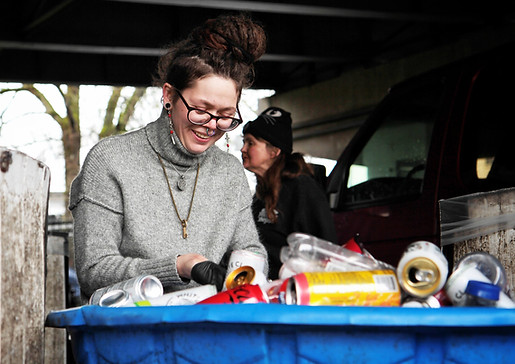
Photo by Brodie Cass Talbott


Total containers processed at TPD:
2025: 10,100,000
2024: 9,450,650
2023: 7,500,439
2022: 3,957,818
2021: 3,834,424
Average # of people served per hour:
2025: 62 customers per hour
2024: 60 customers per hour
2023: 60 customers per hour
2022: 49 customers per hour
2021: 31 customers per hour
Total transactions in 2024: 38,587
Number of payroll workers: 11 (as of April, 2026)


